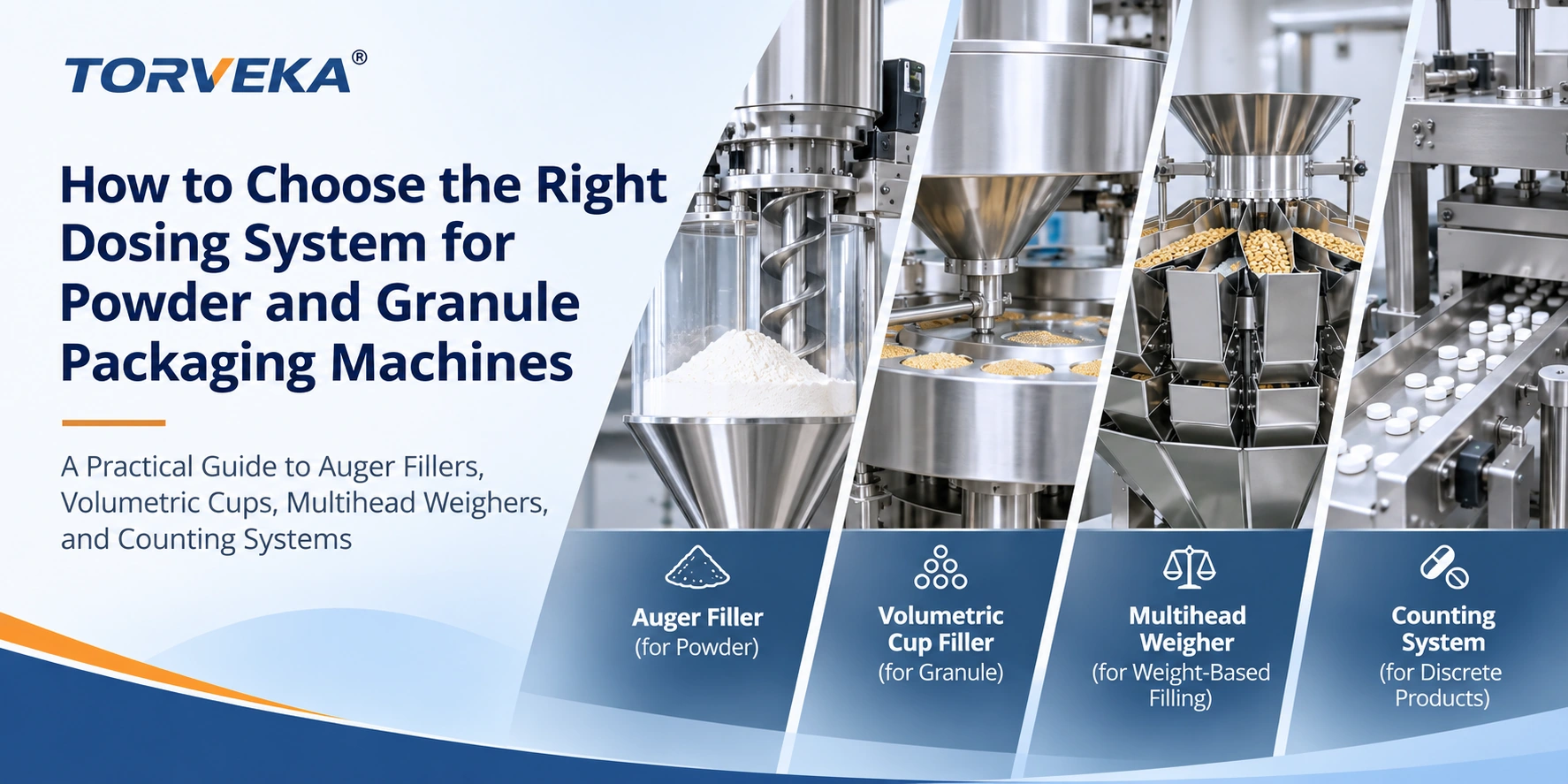
A Practical Guide to Auger Fillers, Volumetric Cup Fillers, Multihead Weighers, and Counting Systems
Selecting a packaging machine involves more than choosing the right packaging speed or bag style. One of the most important decisions is selecting the dosing system — the mechanism responsible for measuring and dispensing the required amount of product into each package.
For manufacturers handling powders, granules, or discrete solid products, the wrong dosing system can result in inconsistent fill weights, material waste, frequent adjustments, or unnecessary maintenance.
Different materials behave differently during filling. Fine powders may generate dust or stick to machine surfaces, while granules can vary in size, density, and flowability.
The right dosing system depends primarily on your material characteristics, target filling quantity, accuracy requirements, production speed, and budget.
This guide explains the most common dosing technologies used in automatic packaging machines, their advantages and limitations, and how to select a suitable configuration for your application.
1. What Is a Dosing System in a Packaging Machine?
A dosing system is the part of a packaging machine that measures and dispenses a controlled quantity of product into a bag, pouch, sachet, or other container.
In an automatic vertical form-fill-seal (VFFS) packaging machine, the dosing system typically works together with the film feeding, bag forming, sealing, and cutting mechanisms.
A complete packaging process generally includes:
- Product feeding and storage
- Product measurement or dosing
- Bag or pouch forming
- Product discharge into the package
- Sealing and cutting
- Finished package discharge
Although these operations are connected, the dosing system directly affects the quantity of material delivered to each package.
An important distinction: dosing accuracy and final package weight accuracy are related, but they are not always identical. Actual performance depends on product behavior, machine configuration, calibration, and operating conditions.
2. Auger Filling Systems for Powder Packaging
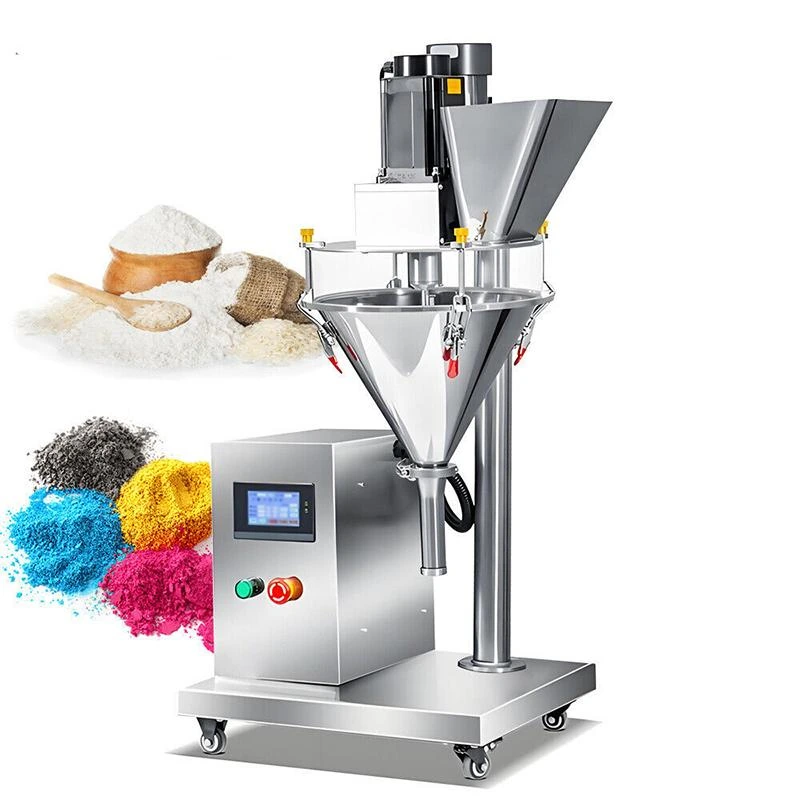
Auger filling is one of the most commonly considered technologies for powder packaging applications.
An auger filler uses a rotating screw to move powder through a filling tube or outlet. The quantity dispensed is controlled by parameters such as screw rotation and filling cycles.
Typical Applications
Auger filling systems are commonly considered for:
- Milk powder
- Coffee powder
- Seasoning powder
- Fine powdered ingredients
- Industrial powder products
- Selected pharmaceutical or nutritional powders, subject to application-specific requirements
Advantages
Adjustable filling quantity
The dosing quantity can be adjusted by controlling screw operation and other machine parameters.
Suitable for a wide range of powders
Auger filling can be configured for many powder products with different bulk densities and flow characteristics.
Established operating principle
The technology is widely used in powder packaging machinery and can be integrated with automatic bag-forming and sealing equipment.
Limitations
Auger filling performance is influenced by material properties.
Changes in bulk density, poor flowability, moisture, or powder adhesion can affect filling consistency.
Some very fine, cohesive, or difficult-flowing powders may require additional feeding or material-handling measures.
When Should You Choose an Auger Filler?
An auger filler is often a practical starting point when packaging free-flowing or moderately flowing powders and when adjustable dosing is required.
However, the final decision should follow a material test rather than relying only on a product description. For a related machine format, see the Powder Back-Seal Packaging Machine; its dosing configuration must be confirmed for your powder.
3. Volumetric Cup Filling Systems for Granules
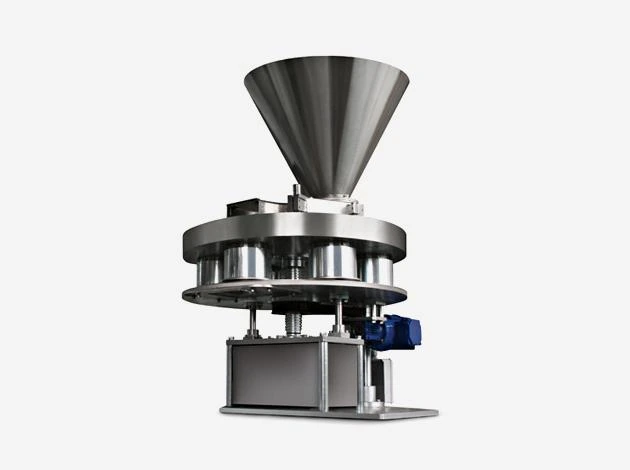
A volumetric cup filling system measures product using a defined volume rather than directly weighing each individual dose.
During operation, granules fill a cup with a fixed or adjustable volume. The measured material is then discharged into the packaging machine.
Typical Applications
Volumetric cup fillers are commonly considered for:
- Sugar
- Seeds
- Uniform dry granules
- Selected cereals
- Desiccant granules
- Other relatively free-flowing granular products
Advantages
Simple mechanical structure
Volumetric systems generally use a straightforward dosing mechanism.
Suitable for repetitive filling
They can be useful when the product has relatively consistent density and flowability.
Practical cost considerations
For suitable applications, volumetric cup filling may offer a comparatively simple solution in terms of machine configuration and maintenance.
Limitations
A volumetric cup measures space occupied by the product, not its actual mass.
If the bulk density changes, the weight delivered by the same cup volume can also change.
For example, two batches of granules may occupy the same volume but have different weights due to differences in particle size, density, or settling behavior.
When Should You Choose a Volumetric Cup Filler?
This system is worth considering when your product consists of relatively uniform, free-flowing granules and your filling requirements can be met through volumetric measurement.
For applications with tight weight tolerances or significant density variation, a weight-based system may be more appropriate. The Standard Sachet Packaging Machine can be configured around granular materials, subject to the selected metering system and material suitability.
4. Swing-Cup Dosing for Granular Products
Swing-cup dosing, sometimes described as oscillating-cup volumetric filling, is another method used for certain granular materials.
The system uses a mechanically controlled cup movement to collect and discharge a measured quantity of product.
Depending on the configuration, the movement may be controlled by pneumatic or servo-driven components.
Typical Applications
Swing-cup systems may be considered for:
- Selected fragile granular products
- Snack ingredients
- Nuts
- Granules requiring a different discharge motion from conventional rotary cup systems
Advantages
The controlled cup movement can provide an alternative way to handle certain granular products.
It may also be useful when the filling mechanism needs to be adapted to the physical characteristics of the material.
Limitations
As with other volumetric systems, filling consistency may be affected by changes in bulk density and material flow.
The motion and cycle design can also limit throughput compared with certain rotary volumetric configurations.
Selection Tip: Do not assume that swing-cup dosing always protects fragile products better. Actual product breakage should be evaluated through testing.
5. Multihead Weighers for Weight-Based Filling
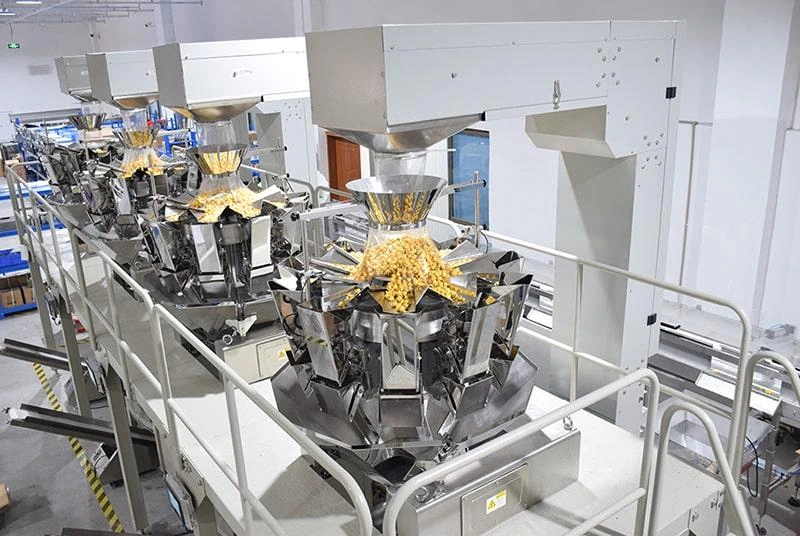
A multihead weigher uses multiple weighing units to measure product portions and select a combination that meets a target weight.
Instead of relying only on a fixed volume, it uses measured weight values to determine the discharge combination.
Typical Applications
Multihead weighing technology is frequently considered for:
- Nuts
- Snacks
- Dried food products
- Irregular granular materials
- Mixed-size solid products
- Applications requiring weight-based portion control
Advantages
Weight-based dosing
The system measures product mass, making it useful when weight accuracy is an important requirement.
Suitable for varying particle sizes
Many granular products with nonuniform shapes can be handled through an appropriately designed weighing system.
Flexible configurations
The weighing system can be integrated with suitable automatic packaging equipment.
Limitations
Multihead weighers generally involve more complex equipment than simple volumetric cup fillers.
They may require more installation space, a higher initial investment, and additional cleaning or maintenance procedures.
The suitability of a multihead weigher for very fine or cohesive powders should be evaluated carefully. Dust, adhesion, and feeding behavior can make some powder applications challenging.
When Should You Choose a Multihead Weigher?
Consider a multihead weigher when weight-based dosing is important and your granular product can be consistently fed, weighed, and discharged.
A material trial is essential for determining whether the equipment is suitable for the intended product.
6. Counting Systems for Discrete Products
Not every packaging application requires filling by weight or volume.
For some products, the required quantity is defined by the number of pieces in each package.
Counting systems may use vibration feeding, sensors, or other counting mechanisms to deliver a specified number of products.
Typical Applications
- Tablets
- Capsules
- Discrete solid pieces
- Selected uniform granular products
- Other count-based packaging applications
Advantages
Counting systems are useful when the packaging specification is based on pieces per pack rather than weight.
They can also support applications where the number of units is more important than the total package weight.
Limitations
Counting performance depends on reliable product separation and feeding.
Irregular shapes, overlapping products, dust, or inconsistent feeding may affect counting efficiency and require special equipment configurations.
7. Comparison of Common Dosing Systems
The following table summarizes the main differences between commonly used dosing technologies.
| Dosing System | Best-Suited Materials | Main Advantage | Main Limitation | Typical Selection Priority |
|---|---|---|---|---|
| Auger filler | Powders | Adjustable screw-based dosing | Sensitive to powder flow and density changes | Powder handling and dosing control |
| Volumetric cup filler | Uniform, free-flowing granules | Simple and repetitive volume measurement | Weight varies with bulk density | Simplicity and cost |
| Swing-cup filler | Selected granular products | Alternative controlled cup movement | Application-dependent speed and consistency | Product handling characteristics |
| Multihead weigher | Granules and discrete solid products | Weight-based portioning | More complex equipment and cleaning | Weight accuracy |
| Counting system | Tablets and individual pieces | Piece-count-based dosing | Requires reliable separation and feeding | Count per package |
Important: The table describes general operating characteristics, not guaranteed machine performance.
Actual speed, filling accuracy, and suitability depend on the selected equipment and product being packaged.
8. How to Choose the Right Dosing System
The most effective selection process starts with the material rather than the machine model.
Step 1: Identify Your Material Characteristics
Before selecting a dosing system, determine:
- Is the product powder, granule, or discrete solid?
- Is it free-flowing or cohesive?
- Does it generate dust?
- Does it absorb moisture?
- Is it fragile or easily damaged?
- Does its bulk density change between batches?
- Is it likely to stick to the hopper or discharge surfaces?
These properties can significantly influence the suitability of a dosing mechanism.
Step 2: Define the Filling Quantity
Specify how much product you want in each package.
For example, a manufacturer may need small sachets, medium-size pouches, or larger retail packages.
The intended filling range affects the dosing equipment configuration.
Step 3: Determine the Required Accuracy
Not every application needs the same measurement method.
For products with relatively stable density and less demanding weight tolerances, volumetric dosing may be sufficient.
For applications where weight consistency is a major concern, weight-based equipment should be evaluated.
Accuracy requirements should be defined using measurable tolerances rather than descriptions such as "high precision."
Step 4: Evaluate Production Speed
The dosing system must be capable of supplying the required quantity of material at a rate compatible with the packaging machine.
A high-speed packaging machine will not deliver its intended output if the dosing mechanism cannot keep up.
The entire system — including feeding, dosing, forming, sealing, and discharge — must operate as a coordinated process. See our Automatic Packaging Solutions for an example of connected packaging stages.
Step 5: Consider Cleaning and Maintenance
Cleaning requirements can be especially important for food, nutritional, and other sensitive products.
Evaluate:
- Access to product-contact components
- Ease of disassembly
- Material residue accumulation
- Changeover requirements
- Cleaning procedures
- Applicable hygiene requirements
The right equipment configuration should support both production and routine maintenance.
Step 6: Test the Actual Material
Material testing is one of the most useful steps before making a final equipment decision.
The same nominal product category can include materials with very different physical characteristics.
For example, two coffee powders may behave differently because of differences in particle size, moisture, or bulk density.
Testing helps identify feeding problems, dosing inconsistencies, product damage, and other limitations before a final machine configuration is agreed upon.
9. Recommended Starting Points by Application
The following recommendations can help narrow down the initial options.
| Packaging Requirement | Dosing System to Evaluate First |
|---|---|
| General free-flowing powder | Auger filler |
| Uniform dry granules | Volumetric cup filler |
| Fragile granular material | Swing-cup or suitable gentle-handling system |
| Granules requiring weight-based dosing | Multihead weigher |
| Discrete products sold by piece count | Counting system |
| Cohesive or adhesive powder | Auger system with appropriate material-handling measures, or a specialized feeding solution |
These are starting points for technical evaluation, not final equipment specifications.
For powders that bridge or stick to equipment surfaces, a specialized feeding mechanism may be necessary. The appropriate solution depends on the material and should be confirmed through trials.
10. Frequently Asked Questions
What is the difference between auger filling and volumetric cup filling?
An auger filler uses a rotating screw to dispense powder, while a volumetric cup filler uses a defined volume to measure the product.
Auger fillers are generally associated with powder applications, whereas volumetric cup fillers are commonly used for relatively uniform, free-flowing granules.
Which dosing system is best for powder packaging?
An auger filler is often a suitable starting point for powder packaging.
However, the best solution depends on powder flowability, bulk density, moisture, filling range, and accuracy requirements.
Cohesive or difficult-flowing powders may require additional feeding or discharge measures.
Is a multihead weigher always more accurate than a volumetric cup filler?
Not necessarily in every application.
A multihead weigher measures product mass, while a volumetric cup measures product volume.
Weight-based dosing can be advantageous when bulk density varies, but actual performance depends on material characteristics, equipment design, calibration, and operating conditions.
Can one packaging machine handle both powders and granules?
Some packaging machine platforms can be configured with different dosing systems for different products.
However, compatibility depends on the machine design, available installation space, control integration, product-contact components, and changeover requirements.
The ability to switch between dosing systems should be confirmed for the specific machine configuration.
What affects the filling accuracy of a packaging machine?
Common factors include material flowability, bulk density, particle size, moisture content, dosing mechanism design, calibration, and operating speed.
Stable feeding and appropriate machine adjustment are also important for consistent filling.
Should I choose the dosing system before selecting the packaging machine?
It is generally more effective to evaluate the dosing system and packaging machine together.
The product characteristics determine the required dosing technology, while the packaging format, output requirements, and overall line configuration determine how that technology must be integrated.
Can a dosing system be customized for a specific product?
Depending on the equipment platform, the feeding mechanism, filling unit, product-contact components, or related modules may be adapted to different applications.
Customization should be assessed against the material properties, required packaging format, and production targets.
11. Choosing a Packaging Solution with TORVEKA
At TORVEKA, we understand that different products require different packaging approaches. Learn more About TORVEKA and our factory.
Choosing the right system involves evaluating the material, dosing mechanism, packaging format, and overall production requirements together.
Whether you are exploring powder packaging, granule packaging, or an integrated automatic packaging solution, a clear understanding of your application is the starting point for selecting suitable equipment.
Request a Packaging Solution
To discuss a suitable machine configuration, please share:
- Product type: Powder, granule, or discrete solid product
- Material characteristics: Particle size, flowability, moisture, or other relevant properties
- Target filling quantity: Required amount per package
- Packaging format: Sachet, pouch, bag, or other format
- Required output: Target packages per minute or hour
- Accuracy requirements: Acceptable filling tolerance
- Additional requirements: Coding, conveying, labeling, or secondary packaging
The more specific your application information, the easier it is to evaluate suitable dosing and packaging options.
Contact TORVEKA to discuss your product and packaging requirements.
TORVEKA — Packaging Machinery & Automation Solutions